



More in Remodeling
Make sure the floor will accept tile. There should be no visible coatings on the floor that would prevent a bond. A completely painted epoxy slab will not bond the tile well. Minor paint and drywall residue is not a problem. Test concrete by dropping water on the surface. If the concrete readily accepts the water by darkening and absorbing, it will receive tile.
Tile weighs a lot, and the flooring has to be strong enough to support it. If the structure underneath is flexible, the tile will crack.
Many existing surfaces are uneven. To get a good bed for the tile, take down the high spots and fill in the low spots and holes. Cracks only get wider over time, so they need to be patched.
Remove the old carpet in sections with a razor knife. Peel up the carpet padding using a hand scraper. Remove the carpet tack strips with a hammer and a flat pry bar.
Remove any excess glue and padding remnants with a floor scraper and a putty knife. Sweep and vacuum the floor clean.
Follow the manufacturer's recommendations for the crack suppression product chosen.
Pencil in the area on the floor where the crack suppression liquid will be applied. Apply the liquid with a combination wide putty knife and heavy napped roller.
Also embed the crack suppression membrane over the liquid with a heavy napped roller. Let dry for at least two hours prior to tiling.
Undercut the hearth using a masonry dry-cut saw (Image 1). The cut size needs to be at least the tile height, plus 1/8" for thin set so it will fit underneath the cut-out stone.
With a hammer and concrete chisel, chip out the material underneath the hearth for the tile insertion (Image 2). Remove all the debris and material from underneath the stone hearth.
It's time to create the layout for the entryway and fireplace tile. Lay out the entryway tile on a dry run and use a pencil to mark where the chalk lines will go for the grid pattern. Measure the center of the fireplace and mark the grid pattern as before. The grid pattern should be the width of a few tiles plus room for grout joints. Take measurements from the main working lines and mark where these grid boxes will go.
Chalk the grid boxes onto the floor with the chalk line. This grid technique eliminates the use or need for spacers, and it allows the setter to go around obstacles such as islands, columns, protrusions and corners into other rooms.
Note: This grid technique also allows the setter to make all the necessary tile cuts in advance.
The grid box is determined by laying out as many tiles with grout-joint spacing that it takes to make up a box size of 2' to 3' (square feet). It will be necessary to reach all the corners of the box with your thin-set trowel when tiling, so don't make the grid box too big.
For example, if the tile is 12" x 12" add the preferred grout-joint spacing (ours was 1/4"), add three grout joints plus the three tiles and the box size should equal 36-3/4".
Chalk the grid pattern on the floor. The chalked-in layout removes the need for spacers. Clear lacquer all the chalk lines so that they do not disappear during the tiling process.
A slab floor can be tiled if the floor is not overly coated with paint or drywall residue, if cracks in the floor are less than 1/8" and if cracks in the floor aren't raised on one side.
Mix the thin set according to manufacturer's specifications with the 1/2" drill motor and the rod-type mixer paddle at less than 600 rpm.
Apply the thin set with the flat end of the trowel to key in the mortar on the concrete slab. Use the notched side to create a uniform thickness. (Lay only enough thin set that can be tiled in 15 minutes.)
Lay the tile on the thin set following the chalk lines, and make sure there's no excess lippage on the laid tiles.
Tap the tiles lightly with a rubber mallet to ensure a good bond to the thin set.
Tip: Do not apply too much pressure on the mallet or the tiles could crack. Tiles can be removed while they are still wet, but never walk on them during the installation process.
Feel the corners of each tile as it is set to make sure there's no excess lippage or height difference from tile to tile. Tap down high tiles. Pull up low tiles and apply extra thin set underneath to raise it. Don't cover up the working lines, which eliminate the use of spacers on the floor.
Consider installing a transition strip (Image 1) to separate the tile and the carpeting. A transition strip is a metal or wood divider between two different flooring materials. It can bridge height differences or simply "transition" between two opposing materials.)
The rock border for the entryway comes in a sheet (Image 2) 3" x 11" with webbing on the back. Press down the border to install (Image 3).
Since the hearth was undercut, the tiles need to be cut to fit underneath. Cut the tiles and slide underneath the hearth.
Note: The tricky part about tiling around stone is making sure the joint between the tile and the stone looks good.
Tip: Number the tiles when tiling around a difficult area to avoid layout mistakes. Number tiles immediately after cutting.
From this point the procedure is the same as for the entryway. Spread thin set as before or backbutter (apply bond to the tile back) the tiles. Let the thin set cure for 24 hours before walking on it or grouting.
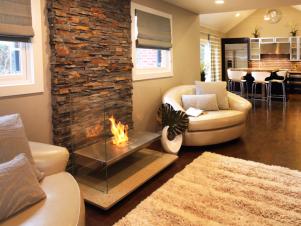
This area has a circular design for the couch. To follow the design and layout (Image 1) of the curved couch and create a circular tile effect around it, curve the tile design and the carpet as well (Image 2).
To help create this curve, install a transition strip to the floor. Use a template that's cut to the same size as the tile to cut radius tiles for this curve (Image 3).
Lay out the tiles dry, place the template in the space where the tiles goes. Hold it firmly in place and use a razor knife to cut around the radius, and follow the metal transition strip around to the other side.
Pick up the template, place it on the tile (making sure the edges fit and are aligned), take a pencil or china marker and trace a "cutting" mark on the tile on the same radius. Lastly, use a wet saw to cut the tile.
Note: Wet saws can be rented from your local hardware store for approximately $45 a day.
Thin set and place the tiles as you did before with the entryway.
Mix the grout per the manufacturer's instructions. The mix should have the consistency of a milkshake.
Apply the grout with a laminated grout float, and push the grout into the joints with the flat edge of the float.
Push the grout over the face of the tiles diagonally with the flat edge of float to cut off excess grout.
Continue the process over the entire floor until all the joints have been grouted. Allow the grout to set and haze over.

With a nearly dry sponge, tool the grout to eliminate pinholes, voids, highs and low spots.

Do a final wipe with a nearly dry sponge pulled diagonally over the face of the tile to remove any grout residue.
Once the grout has hazed over, polish the face of the tiles with cheesecloth.
Note: Grout should set for 24 hours before you can walk on it.
The platform for the couch is constructed in three sections (Image 1). Measure the outside dimensions of the couch.
Construct the sides of the platform with 2" x 4"s (Image 2), and then attach the plywood with screws.
Note: Make the platform as high as the tile is wide.
Attach the backer board to the outside edge of the platform with backer board screws.
Warning: Tile can't set on 1/4" fibrous wood. Backer board is needed so the tile will adhere to the platform.
Tile the outside of the platform just like you tiled the floor (Image 1).
Note: With this particular project, the same mustard colored field tile was used for the front curved part of the platform (Image 2).
Measure and cut the curved tile pieces the same way as the floor field tiles.
Apply the thin set and place the tiles carefully. Use a beating block and rubber mallet to "lightly" tap the tiles into place.
Set the small 2" x 3" curved pieces in a vertical pattern along the curved area on the front of the platform. The cut tile will easily form to the curve.
Once the thin set has cured for 24 hours, you can grout the platform tile the same as the floor tile. Using the grout float, apply a small amount to the surface. Use fingers to apply grout to difficult areas.
After the grout has cured, clean it with a nearly dry sponge, and then repeat the step to clean off the excess grout. Don't forget to let the grout set for 24 hours.
Advertisement
All fields are required.
Signing in

Please enter your email address and we will send your password
E-mail Address
Your password has been sent and should arrive in your mailbox very soon.
Sign up with DIY Network to share tips with other do-it-yourselfers and comment and ask questions on projects.
It's free and easy.