
DIY Network

All Projects

TV Projects

    What Do You Want To Work On?

      What Activity Do You Want To Do?

        0

        Available Projects

        Get Results

        How to Maximize Sound in a Home Theater

        Learn how to set up surround-sound for maximum effectiveness.

        More in Decorating

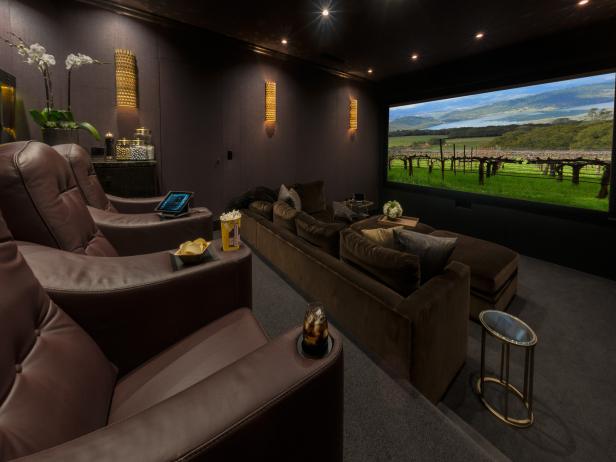
        set home theater speaker for maximum effectiveness Watch Video
        • Time

          Under Half Day

        • Price Range

          $250 - $500

        • Difficulty

          Moderate

        Highlights:

        Step 1: Determine Where to Put the Speakers

        Sound can only do three things in a room: Reflect and stay inside the room, absorb into the walls, or transmit into areas outside the room.

        Since the goal should be to keep sound inside the room, it's important to have some reflection and absorption and to reduce the amount of transmission.

        To get the most out of a surround-sound system, it's important to place the speakers in the best sounding locations. Take the room dimensions and divide into thirds. Typically the best location for sound, is a third of the way back from the screen, but if the screen is so large it means placing your speakers too far out into the room, good sound can also be achieved on the fifth and seventh dimensions of the room.
        Step 2: Place the Surround-Sound Speakers

        Determine placement for the surround-sound speakers. Normally, there is a center channel, front, left and right speakers, two surrounds and two subwoofers.

        The center-channel speaker is the most important speaker in the surround-sound system. Most of the dialogue and effects are coming from the center speaker. The best location for the center-channel speaker is the front of the room, preferably behind a perforated screen. With a non-perforated screen, the location will have to be either below or above the screen.
        For the subwoofer placement, there are differing opinions. Some manufacturers advise putting the subwoofer in the corner for the smoothest response, but other manufacturers recommend bringing the subwoofer out into the room.
        Do some listening in order to see which position best suits the room.

        For left and right speakers, it's best to experiment to find the best placement within the listening environment. Placing speakers far apart creates a wider sound stage, and placing them closer together works with limited wall space.

        There are two types of surround-sound speakers:
        Direct Radiator -- The standard type of speaker that goes in front. The best locations for these speakers are the back corners of the room. The general rule is about 120-degrees spaced apart from behind the listener's head.

        Dipole Surround -- Shoots the sound forward and backward for more enveloping effect. These speakers create a very diffuse sound field, and they are best located on the side walls directly beside the seating location.

        People who listen to lots of music on their system tend to go for the direct radiator speakers, and those who watch lots of movies tend to go for the dipole surround speakers.

        Step 3: Final Room Layout

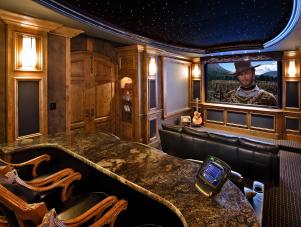
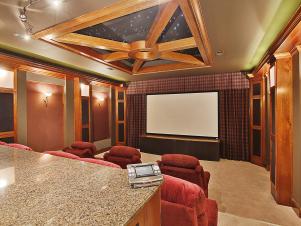
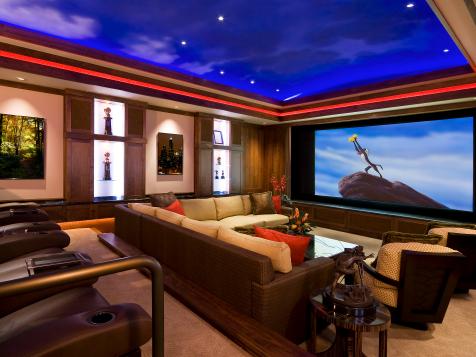
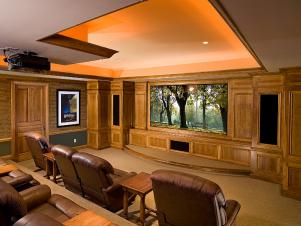
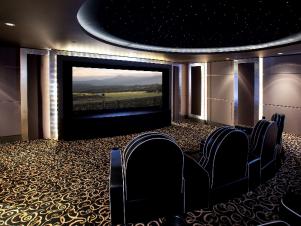
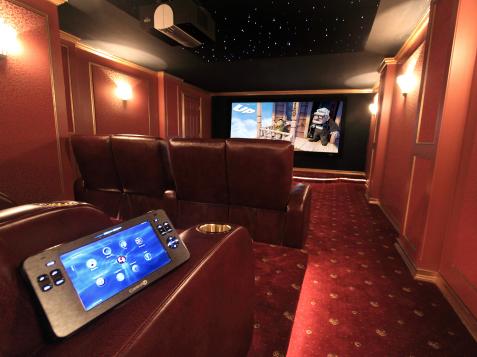
        Here's how we laid out the room:

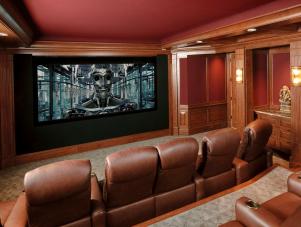
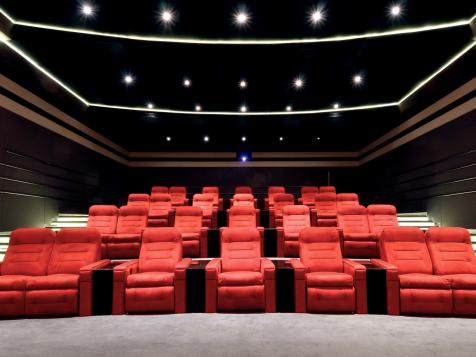
        Two chairs placed two-thirds of the way back from the non-perforated screen and one-third in from each side wall.

        All audio-visual components stored out of sight in an adjoining room.

        The front-left and front-right speakers hidden in the wall on each side of the screen.

        The center-channel speaker mounted above the big screen.

        The subwoofers hidden in a cabinet below the screen.

        The dipole-surround speakers will be mounted on the wall to the sides of the listening position.

        Learn how adding a home theater can boost your home's value at HGTV's FrontDoor.com

        decide on theater room layout

        All About…

        More Topics

        Was this project helpful?

        Don't forget: Read comments and leave your own

        Advertisement

        Projects

        COMMENT ON THIS PROJECT


        Sign in

        All fields are required.

        E-mail Address:

        Password:

        Remember me on this computer

        Signing in

        Please enter your email address and we will send your password

        E-mail Address

        Your password has been sent and should arrive in your mailbox very soon.

        Not a member?

        Sign up with DIY Network to share tips with other do-it-yourselfers and comment and ask questions on projects.

        It's free and easy.