




More in Remodeling
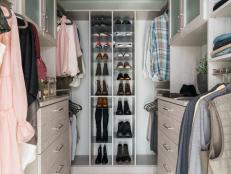
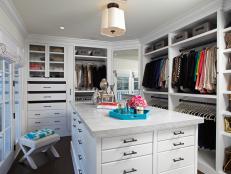
The first thing to do is decide on a design for the closet. Think of each wall as a reach-in closet. Measure each wall separately and plan the storage one wall at a time, take personal needs into account. If one person is using the closet, it's a good idea to put the hanging wardrobe rods on the left and right sides of the closet and turn the corner with shelves — this makes a great use of the corner space (Image 1).
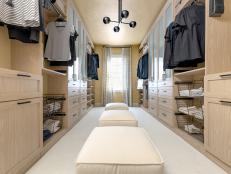
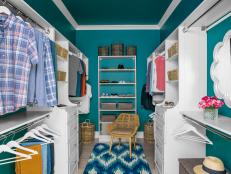
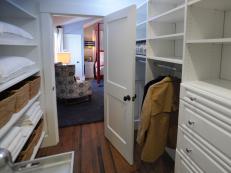
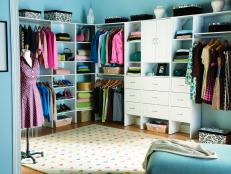
When two people are sharing a master closet, it works well to lay out the design with one wall for each person (Image 2). If there is enough space, think about adding a tower between the hanging sections on each side. The towers hold long vertical clothes, shelves, drawers and baskets. Then the back wall can be shared space (Image 3). This type of planning is a critical first step toward a great closet. Figure out what is needed as well as desired. Take an inventory of closet items. A little pre-planning will save time and money.
Order the closet system in advance. Closet systems are also available at home stores and can be purchased the day you plan to do the project. All the supplies needed come with the kit.
Remove all the clothes and take out all the racks.
Patch all the holes with spackle. Lightly sand the walls and then paint them.
Mark the walls where the track will be placed. The track is the backbone of the design and supports the whole system. The placement is determined by the desired design. Mark the studs in order to secure the track properly — the track must be installed into the studs.
If some panels are placed in-between studs, toggles will need to be installed. Drill a 1/2" hole on both sides of panel location. Slide the metal channel through the hole and pull it so it is flat behind the wall. Slide the plastic cap along the straps until the flange is flush with the wall. Push side to side to snap off the straps at the wall.
Expert Tip: The tracks come in 4' and 8' lengths. If the closet is more than 8', it may be necessary to cut the track back to the nearest stud and then start the new track beyond that. It's very important to install the track into the studs.
The track must end on a stud, if it is too long, cut the track with a hacksaw. Drill the track in place around the perimeter of the closet.
Assemble the tower for the back wall by screwing it together.
Expert Tip: When installing a tower section, it is also important to use a cleat, besides just the track. This will keep the unit from moving side to side. The cleat can be mounted under any of the fixed shelves and will give the unit extra support.
Hang the organizer on the track. Screw the attached cleat into the wall.
Use shelf pins to add more adjustable shelves, and continue adding panels. When adding fixed shelves to the top of the panel, secure them on the outside of the panel, making them extra sturdy.
Use rod ends to hang the wardrobe rods (Image 1).
Screw in all the shelves on the outside, use corner brackets (Image 2) to support the corner shelves.

To build the drawers, run a strip of glue down the miters. Put a drop in each hole and put the bottom of the drawer in place (Image 1).

Fold the drawer into position and use a rubber mallet to tap it into place.
Make sure it is square and screw the knob onto the drawer face.
Attach the face to the drawer, screw it into place, and attach glides (Image 2).
Attach glides on the panel at the height where you want the drawers.
Add accessories.
Small reach-in closets can have more storage too. Measure the space and then take inventory and come up with a design.
Expert Tip: In a small closet with bifold doors, place drawers toward the center and hanging storage to the right.
If there is plenty of hanging space, but more folding space is needed for clothes and toys, put a tower in the center that has shelves, drawers and baskets. Place the hanging clothes on the side. This will double the storage space in the closet.
Note: Adjustable systems are especially practical for children's closets.
Advertisement
All fields are required.
Signing in

Please enter your email address and we will send your password
E-mail Address
Your password has been sent and should arrive in your mailbox very soon.
Sign up with DIY Network to share tips with other do-it-yourselfers and comment and ask questions on projects.
It's free and easy.